REVIEW · BIKE & E-BIKE TOURS
Bologna Panoramic Bike Tour
Book on Viator →Operated by TRAVELHOO · Bookable on Viator
Bologna looks different from a bike. This 2-hour panoramic ride gives you English narration and a small group route through the city’s big sights, from iconic towers to major squares. Just plan for one thing: the city center can feel busy, with cars and pedestrians sharing the road, so you’ll want to stay switched on during the tighter stretches.
I like that the tour keeps momentum. You’re not stuck in long museum lines or long lectures. Instead, you get quick stops—each one designed to give you a clear moment to look up, orient yourself, and move on—so the whole loop feels efficient without feeling rushed into chaos.
In This Review
- Key highlights you’ll feel fast
- Bologna by bike: why this works (and where it can get tricky)
- Getting started at Via Caduti di Cefalonia (and what the ride feels like)
- Cavaticcio and Torre Prendiparte: Bologna’s mix of old power and modern energy
- Le Due Torri and the Via Emilia entrance point
- Piazza Maggiore: medieval meeting place and the stark beauty of San Petronio
- Archiginnasio di Bologna: a former university that still feels academic
- Basilica di San Domenico: art, the Dominicans, and the story behind the stones
- Santo Stefano’s Seven Churches: faith complex energy in a compact stop
- Price and value: what $54.07 buys you in real terms
- Tips to make the ride feel easy in Bologna’s streets and weather
- Should you book this Bologna Panoramic Bike Tour?
- FAQ
- Where does the Bologna Panoramic Bike Tour start?
- How long is the bike tour?
- How much does the tour cost?
- Is the tour offered in English?
- Do I need to print a ticket?
- What is the maximum group size?
- What stops and sights are included?
- Are admission tickets included for the stops?
- Is the tour close to public transportation, and are service animals allowed?
- What happens if the weather is bad or I need to cancel?
Key highlights you’ll feel fast
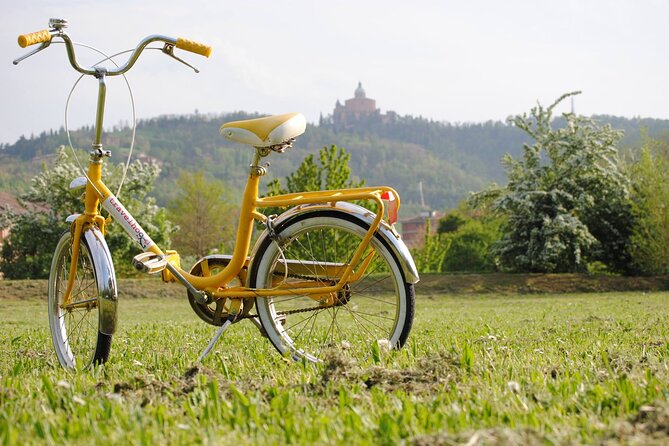
- A 2-hour panoramic route that packs major Bologna landmarks into one smooth morning plan
- English-led narration with a guide who connects what you see to how the city works
- Seven signature stops ranging from medieval towers to the Seven Churches complex
- Short 5-minute viewing windows that make it easier to cover ground even when the streets are active
- Admission-free stops at every listed site, so you pay for guiding and time—not entrance fees
- A capped group size (max 15), which matters when you’re weaving through narrow lanes
Bologna by bike: why this works (and where it can get tricky)
Bologna is one of those cities where the streets practically teach you how to read them. You’ll see towers, porticoed streets, and plazas that were meant for meeting, trading, and showing off power. Pedaling through it means you’re moving at a human pace—fast enough to cover a lot, slow enough to actually notice details like stonework, façades, and the way the buildings frame the road.
The flip side is that bikes and busy city centers don’t always get along. One of the most practical things to know: you’ll likely spend time around junctions where foot traffic is thick and cars need space to pass. That doesn’t mean it’s unsafe, but it does mean your attention needs to be on the road, not just on photos. If you’re anxious in traffic, this is still doable—but pick the calmest moments to take pictures and don’t linger in the road.
You can also read our reviews of more cycling tours in Bologna

Getting started at Via Caduti di Cefalonia (and what the ride feels like)
The tour starts at Via Caduti di Cefalonia, 4, 40125 Bologna BO, Italy, and it ends back at the same meeting point. That makes the experience simple: once you’re there, you can plan the rest of your day without guessing where you’ll pop out.
Timing matters here. The ride runs for about 2 hours, and the plan is built around quick viewing stops (each listed stop is about 5 minutes). With seven stops, that adds up to a steady rhythm: look, learn the key context, snap a photo if you want, then roll to the next landmark.
You’ll also benefit from the small group size—up to 15 people. Smaller groups usually mean less gridlock at turns, fewer bottlenecks near curb edges, and easier pacing when you’re dealing with pedestrians.
Practical notes that can affect your comfort: the experience is offered in English, and it uses a mobile ticket. It’s also described as near public transportation, and service animals are allowed. Most people can participate, but since you’re biking, you should still be comfortable riding at city speed for short segments.
Cavaticcio and Torre Prendiparte: Bologna’s mix of old power and modern energy
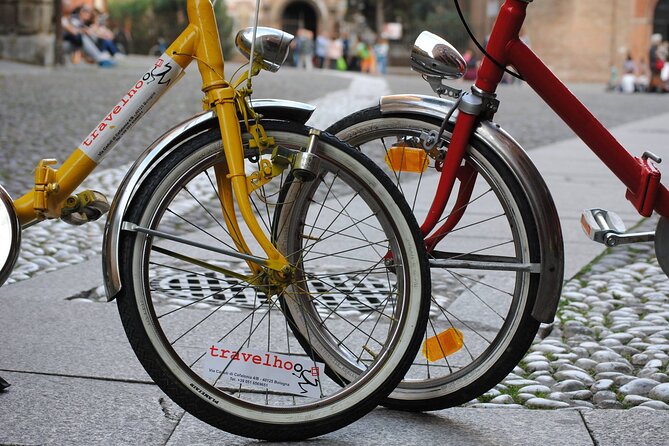
The first stop is Cavaticcio, a park that’s now part of a larger cultural and entertainment hub connecting areas around MAMbo, the Cassero, and the Cineteca. In summer, this is the kind of place that turns into festival ground. The value of starting here is simple: it gives you a quick sense that Bologna isn’t frozen in medieval time. The city layers its new life right next to its historic identity.
Next you hit Torre Prendiparte, a tower built in the 12th century by the Guelph family of Prendiparte to guard against enemy attacks. It reaches 60 meters, landing it just behind Asinelli in height—so even before you see the most famous duo, you’ll already understand how seriously Bologna takes its skyline.
Why these early stops matter: they set you up for the tower theme later. You’ll look up differently once you’ve seen how these structures were built as protection and status, not just decoration.
Le Due Torri and the Via Emilia entrance point
Now the tour hits the big symbol: Le Due Torri (Torre degli Asinelli). This is the classic Bologna image—towers rising in the heart of the city, tied to the ancient Via Emilia. The key idea to watch for is location. Bologna’s identity is written into where streets meet and where the city funnel guides people in and out, and this area is one of those anchors.
A quick 5-minute stop means you won’t get a long explanation while standing still, but you also won’t lose the feeling of moving through the city. Use this moment to do two things:
- Take a wide shot showing how the tower sits in the street grid.
- Look for how the surrounding buildings guide your eye back to it.
This part works especially well if you come in with only a vague idea of Bologna. By the time you leave, you’ll know the city’s visual “home base.”
Piazza Maggiore: medieval meeting place and the stark beauty of San Petronio
Then you’re in Piazza Maggiore, the kind of square that has been a meeting point for centuries. That’s not just trivia—it changes how you look at the space. A large plaza like this isn’t meant for quick passing through. It’s meant for stopping, gathering, and watching.
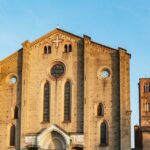
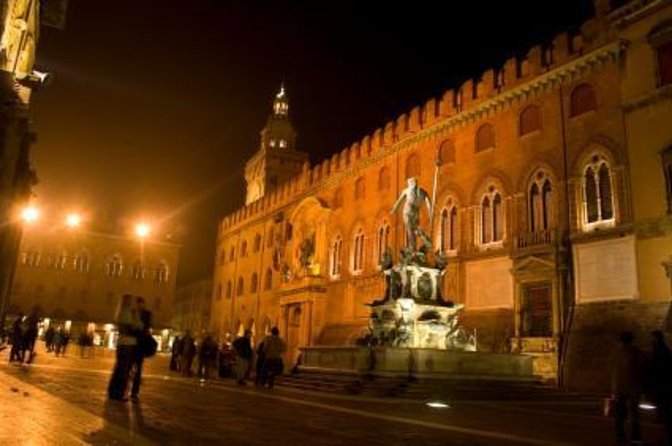
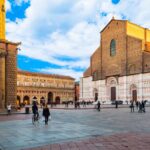
You’ll see it framed by major medieval buildings, including Palazzo del Podestà and Palazzo d’Accursio, plus the imposing Basilica of San Petronio. One of the most striking visual details here is that its façade is incomplete and appears in a gray finish. That unfinished look is part of the story of the city itself: Bologna didn’t build everything at once, and the result still tells you something about priorities and history.
Because your stop time is short, don’t try to “cover” the whole square in five minutes. Instead, pick a focal path:
- Start by locating San Petronio from where you pause.
- Then glance around the square to match the palazzi to the corners you pass later.
That quick mental map will pay off when you walk around on your own afterward.




Archiginnasio di Bologna: a former university that still feels academic
Your next landmark is Archiginnasio di Bologna, described as one of the city’s most important buildings. It was the seat of the ancient University, so the atmosphere you’re looking for is different from a church or a fortress-like tower.
Even with only a brief stop, the place helps you understand Bologna beyond food and streets. Bologna was built on education and institutions, and that shows in how the city organized important spaces. If you like the feeling of stepping into a place that shaped generations of thinkers, this stop hits that note fast.
Since you only have minutes, I’d use the time to orient rather than “read everything.” Look at the overall entrance feel and how the building sits in the historic center. Then, later, if you want more, you’ll know what to search for and where to point yourself.
Basilica di San Domenico: art, the Dominicans, and the story behind the stones
Next up is Basilica di San Domenico, one of Bologna’s richest churches in art. It was erected by the Dominican Friars as a resting place for the remains of San Domenico di Guzman, the order’s founder, who arrived in Bologna around 1200.
This stop works because it connects art to purpose. When you understand that the church ties to a specific figure and a specific religious order, you can start reading details with a goal in mind: the building wasn’t just constructed; it was commissioned with meaning.
Again, five minutes is not enough for an art study. But it is enough to do something practical: notice the scale and the style cues so you can recognize the basilica’s character later if you pass it again.
Santo Stefano’s Seven Churches: faith complex energy in a compact stop
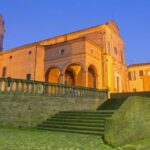
The final major stop is Santuario di Santo Stefano, a complex of religious buildings in Bologna. It’s also known as the Seven Churches complex, and it overlooks the square of the same name.
The value here is that you end with a place that feels like a whole mini-world rather than one single façade. Even in a short stop, the idea of multiple churches in one complex gives you a different kind of visual memory: you’re not just looking at one building, you’re looking at a layered system of sacred spaces.
If you want a take-away that helps when you explore later: think of this site as a “city within the city.” You’ll recognize the area quicker once you’ve tied the churches to a specific square location.
Price and value: what $54.07 buys you in real terms
At $54.07 per person for about two hours, this isn’t a budget stroll, but it also isn’t priced like a long, high-ticket day tour. The value comes from three things you can feel while you’re riding.
First, the stops are admission-free as listed for each location. That matters because you’re not paying entrance fees for every landmark you touch. You’re paying for guide time and the effort of organizing a smart route.
Second, you’re getting a guided narrative instead of a random bike loop. Bologna’s key sights are obvious on postcards, but the connective tissue—the “why this matters” layer—is what makes a short tour worth it. You’ll get the thread linking towers, civic power, university life, and religious art.
Third, small group size keeps the ride smoother. When you’re biking through historic streets, comfort isn’t just about the bike—it’s about how often you have to stop, wait, or thread through crowds. A cap of 15 people supports that.
Is it better than self-guided biking? If you know Bologna well and love reading signs, renting a bike and exploring on your own could be a great option. But for most first-time visitors, a guided loop like this saves hours of figuring out where to start and what to notice.
Tips to make the ride feel easy in Bologna’s streets and weather
This experience requires good weather. If weather turns, you’ll be offered a different date or a full refund, so keep an eye on forecasts if your trip is tight.
Here are practical ways to make the ride smoother:
- Wear comfortable shoes. You’re moving quickly between short viewing stops.
- Plan for sun or heat if you’re going in warm months. The tour is short, but you’re still outside.
- Stay alert at intersections and in crowded pedestrian areas. Bikes have to share space.
- If the narration uses audio equipment, test it early. One person reported headset audio issues during the tour, so don’t ignore strange sound right away.
If you’re going on a calmer day (timing can change street pressure), the experience can feel extra relaxed. Bologna traffic and crowd levels swing by day and events, so your comfort can improve simply by choosing a sensible time of day.
Should you book this Bologna Panoramic Bike Tour?
Book it if you want a high-signal introduction to Bologna without spending your whole morning figuring things out. It’s a smart pick when you care about context—towers that were built for defense, a square that’s stayed a meeting point for centuries, churches tied to specific orders and figures—and you want that story delivered while you’re actually looking at the buildings.
Skip it (or consider a different style of tour) if you’re sensitive to active city-street biking or you strongly prefer long stops and slow pacing. With about 5 minutes at each landmark, it’s designed for movement and orientation, not lingering.
If you’re the type who likes to get your bearings fast, this one is a great way to start your Bologna day—then you can return on foot to the places that grabbed you most.
FAQ
Where does the Bologna Panoramic Bike Tour start?
The tour starts at Via Caduti di Cefalonia, 4, 40125 Bologna BO, Italy. It also ends back at the same meeting point.
How long is the bike tour?
The duration is listed as about 2 hours.
How much does the tour cost?
The price is $54.07 per person.
Is the tour offered in English?
Yes, English is available.
Do I need to print a ticket?
No. You’ll use a mobile ticket.
What is the maximum group size?
The tour has a maximum of 15 travelers.
What stops and sights are included?
The tour route includes: Cavaticcio, Torre Prendiparte, Le Due Torri (Torre degli Asinell), Piazza Maggiore, Archiginnasio di Bologna, Basilica di San Domenico, and the Basilica/Santuario di Santo Stefano (Seven Churches complex).
Are admission tickets included for the stops?
Admission is listed as free for each of the listed stops.
Is the tour close to public transportation, and are service animals allowed?
Yes. It’s described as near public transportation, and service animals are allowed. The tour also notes that most travelers can participate.
What happens if the weather is bad or I need to cancel?
The tour requires good weather. If it’s canceled due to poor weather, you’ll be offered a different date or a full refund. You can also cancel for a full refund up to 24 hours in advance.