REVIEW · CITY TOURS
Discover Bologna an amazing city
Book on Viator →Operated by Alliet’ARTI Tours - Manuela Roversi · Bookable on Viator
Three hours to get your Bologna bearings. This private intro tour is built for first-timers who want the key sights without getting swallowed by crowds, led by longtime Bologna resident Manuela Roversi.
I love the tight route: major monuments plus the food side of town, so the city feels understandable fast. One thing to plan for: you’ll hit places of worship, so a dress code may be required, and the Santo Stefano complex is closed on Mondays.
In This Review
- Key things that make this tour worth your time
- A 3-hour private Bologna kickoff that beats the crowds
- Piazza Maggiore and Neptune Fountain: Bologna’s civic drama
- Via Rizzoli’s Roman line and the leaning-tower mindset
- San Petronio’s sundial and what to wear
- Quadrilatero market lanes and Bologna’s La Grassa attitude
- Archiginnasio and Bologna’s teaching legacy
- Piazza Santo Stefano’s Seven Churches (and Monday closure)
- Strada Maggiore arcades: Casa Isolani’s 9-meter portico
- Two Towers finale at Torre della Garisenda and Torre degli Asinelli
- How I’d use this tour to plan the rest of your Bologna days
- Price value: $125.10 per group and what’s actually included
- Should you book this private Bologna intro tour?
- FAQ
- How long is the Bologna tour?
- Is this tour private, and what group size is allowed?
- Is the tour offered in English?
- Where does the tour start and end?
- Are any attractions ticketed?
- Is there a dress code?
- Is the Santo Stefano complex open every day?
- Do I need transportation included?
- What’s the cancellation policy?
Key things that make this tour worth your time
- Private group (up to 10): more guide attention than big, packed walking tours.
- Manuela Roversi, a true Bologna insider: stories and context that turn stone and streets into a real city.
- A best-of route in about 3 hours: you’ll see the most important sights in one half day.
- Mostly free entry stops: many highlights are free, with only an optional extra fee for the anatomy theatre.
- Quadrilatero food market stop: Bologna’s famous “La Grassa” culture shows up early, not as an afterthought.
- Seven Churches stop with real context: multiple eras in one complex, plus a heads-up about Monday closures.
A 3-hour private Bologna kickoff that beats the crowds
Bologna is the kind of city that rewards getting your bearings quickly. It sits halfway between Venice and Florence and works as a major transport hub, so it’s easy to reach—but it also means you can show up on a day when the center gets busy. This tour is designed to beat that problem with a private format and a route that moves through the historical core.
The duration is about 3 hours, and you’ll cover a lot of ground via central streets and piazzas, finishing near the Two Towers. It’s offered in English, which makes it simpler to follow details like what you’re looking at and why it matters. And because it’s private (up to 10 people), you should expect a calmer pace and more room for questions.
If you’re the type who likes to do one good “orientation” day—then spend the rest of the trip exploring on your own—this fits nicely. Just remember this is a walking tour, so you’ll want to be comfortable moving through the old center.
You can also read our reviews of more city tours in Bologna

Piazza Maggiore and Neptune Fountain: Bologna’s civic drama
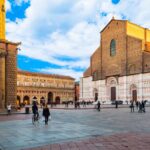
You start at Piazza Maggiore, Bologna’s historic center going back to Roman times. The square is surrounded by major monuments, so it’s not just a pretty backdrop—it’s the city’s civic stage. You’ll see the Basilica of San Petronio, the Neptune fountain area nearby, and classic civic buildings that help explain how important this city has long been.
From there, the tour moves to the Fontana del Nettuno (Fountain of Neptune). This is the kind of fountain that feels more like a statement than decoration. The design reflects Mannerist taste from the mid-sixteenth century, with Neptune’s trident as a key symbol. A fun, very specific detail: the trident was used by the Maserati brothers as an emblem for their first car, and it still shows up in the Maserati company logo. It’s a reminder that Bologna’s influence doesn’t live only in textbooks.
Practical note: both stops are marked as free admission, so you’re not juggling tickets while you’re trying to enjoy the views and the architectural “read” of the city.
Via Rizzoli’s Roman line and the leaning-tower mindset
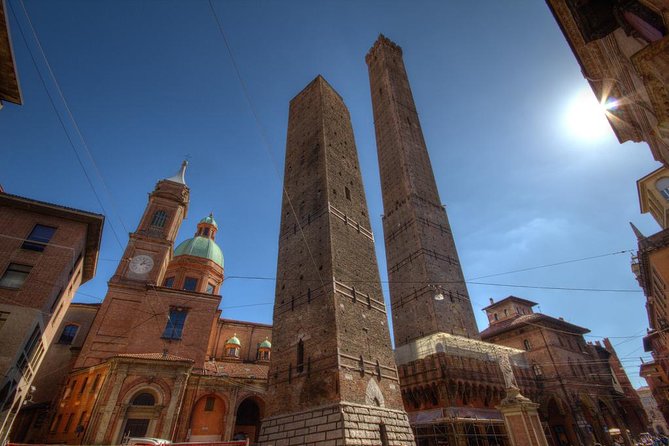
Next comes Via Rizzoli, which—along with Via Ugo Bassi—follows the main Roman axis of Bologna and connects back to the Roman Via Emilia built in the 2nd century B.C. This is one of those moments where Bologna suddenly clicks: you’re walking a line that’s older than most of the buildings around it.
From Via Rizzoli, you get views toward the two medieval leaning towers, Bologna’s signature skyline. Even if you haven’t reached them yet, it helps to spot them early, because they become your visual compass for the rest of the tour.
The area also connects you to Via Indipendenza, a shopping stretch, which gives you a sense of how the historical spine of the city still shapes daily life. In other words, you’re not just seeing old monuments—you’re seeing how the old city keeps functioning.
If you like architecture that tells a story through street layout, this is a good stop. If you’re mostly chasing photos, it still helps because the towers become the end goal you can work toward.
San Petronio’s sundial and what to wear
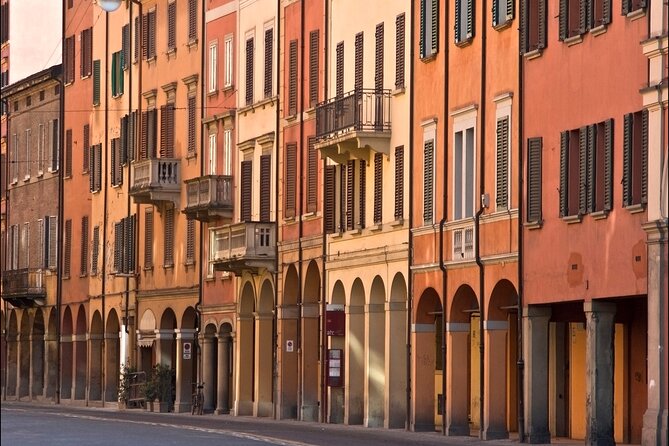
Basilica di San Petronio is huge, and it plays multiple roles in Bologna’s story. One of the big historical points connected to the building: Charles V became the last Holy Roman Emperor to be crowned by a pope here in 1530. The church also hosted part of the Council of Trent and reflects the Counter-Reformation period.
But San Petronio isn’t just about events. It includes a famous scientific detail: a meridian line inlaid in the paving of the left aisle from 1655. That line is the longest covered sundial in the world. So yes, you get politics and religion—and you also get a building that once helped measure time in a very physical way.
Here’s the practical consideration that matters most: a dress code is required to enter places of worship. If your outfit doesn’t fit, you might be refused entry. So before you go, plan clothing that meets a typical church dress standard (covered shoulders and appropriate length). Even if you only care about the architecture, this is the one detail that can derail your visit.
Quadrilatero market lanes and Bologna’s La Grassa attitude
Bologna is famous for food, and Quadrilatero is the neighborhood where the culture shows up in the most immediate way. This stop takes you into the Quadrilatero market area—narrow streets with packed vendors and old-style food stalls that feel like medieval Bologna pushed forward into today.
Locally, Bologna is known as La Grassa (the fat one). That nickname isn’t just marketing. It points to how central eating is to identity here, and Quadrilatero is where you see it without needing a lecture. You’ll be surrounded by the kind of small-scale commercial life that only works in a dense old city layout.
Timing-wise, this is one of the nicest stops because it breaks the pattern of “look, learn, move on.” It gives you a chance to slow down, browse, and connect the city’s monuments to the everyday rhythms that keep Bologna alive.
Since admission is listed as free, you can also treat this stop as flexible. If you want to spend extra time looking at stalls, you can—then rejoin the group when you’re ready.





Archiginnasio and Bologna’s teaching legacy
Archiginnasio di Bologna is your university stop, and it’s a strong one. The building was created to give a more unified seat to university teaching that had been dispersed in different places. In other words, Bologna’s academic culture wasn’t accidental—it was organized and institutional.
The interior decoration is described as an important heraldic wall complex, which is exactly the kind of detail that makes Bologna feel like it has layers. If you care about how power and education show up in physical spaces, you’ll like this stop.
There’s also an optional extra: on request, you can visit the old anatomy theatre. The entrance fee is listed as €3 per person, paid directly on the tour date. So if you’re curious about anatomy and early science education, this is your add-on. If you’re not, you still get the main university building stop.
Admission is listed as free for the main visit, so the optional €3 is a small choice rather than a big budget surprise.
Piazza Santo Stefano’s Seven Churches (and Monday closure)
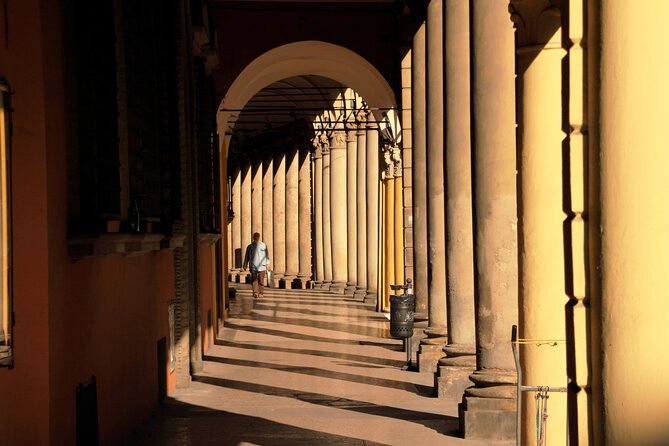
Piazza Santo Stefano is often called Piazza delle Sette Chiese, the Seven Churches square. It’s a pedestrian square near the beginning of via Santo Stefano, and the complex of Santo Stefano sits right there, which makes it easy to understand why it’s such a focal point.
This stop is useful because it shifts you from “single monument” sightseeing to a complex religious landscape. Instead of one church, you’re dealing with a whole collection of buildings and eras within one site, including:
- the Church of Saint Stephen (8th century)
- the Church of the Holy Sepulchre (5th century, rebuilt on a Roman temple)
- the Church of Saints Vitale and Agricola (5th century, rebuilt first in the 12th century)
- the Courtyard of Pilate
- the Church of the Trinity or of the Martyrium (13th century)
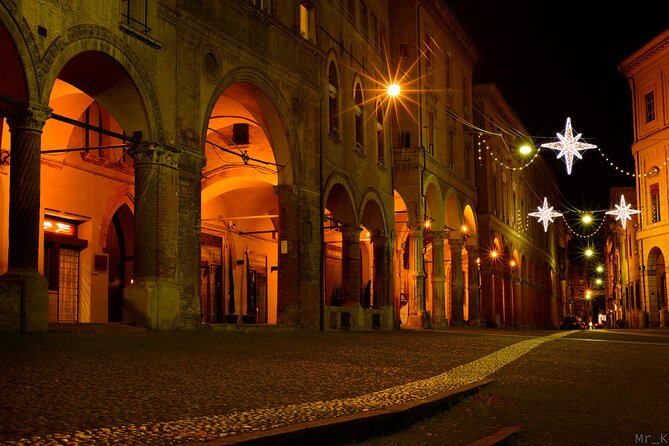
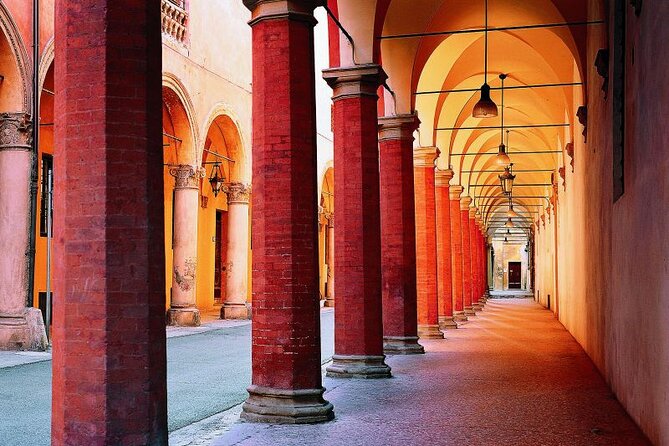
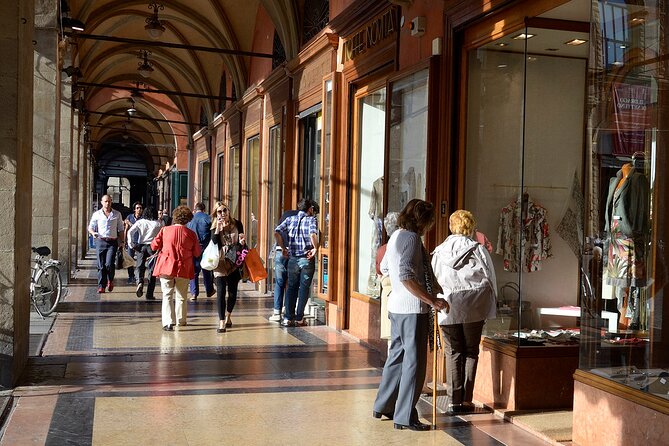
Porticos line the long sides of the square, which also helps you appreciate how Bologna’s covered walkways shape daily movement.
The one timing drawback you should take seriously: the complex is closed on Mondays (at the moment). If your trip lands on a Monday, plan for the possibility that you’ll miss this part or need to adjust expectations.
Strada Maggiore arcades: Casa Isolani’s 9-meter portico
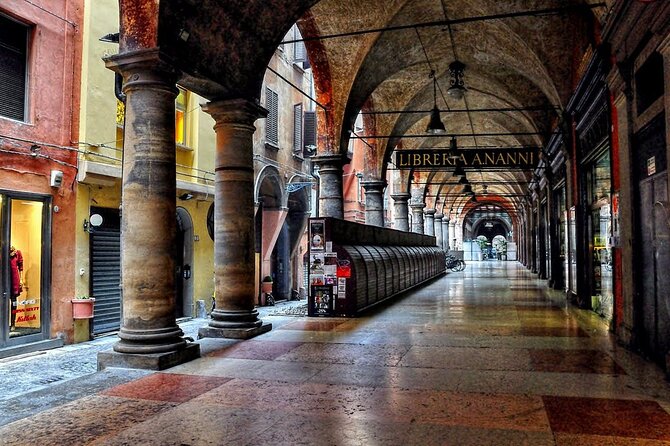
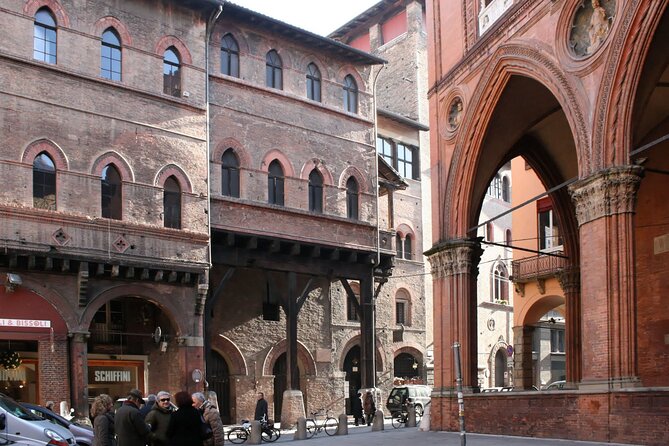
Strada Maggiore is where the tour leans into Bologna’s residential and civic architecture through an unforgettable arcade example: Casa Isolani. You’ll see a gallery linking Strada Maggiore and Piazza Santo Stefano. On one side, the entrance aspect looks like a medieval house with Romanesque-Gothic elements. On the other side, you get a Renaissance-style senatorial palace view.
Casa Isolani is described as one of the most evocative Bolognese arcades, and the specifics are what make it interesting: oak beams around 9 meters tall support the third floor. It was built in the middle of the 13th century and is noted as the highest wooden portico in the city.
This stop is especially good if you’ve been wondering how Bologna stays “human scale” even when it’s old. The answer is in details like these arcades—covered spaces that protect pedestrians and keep the city walkable.
Admission is listed as free, so you can enjoy the architecture without turning it into a budget item. The main value here is learning how the city’s forms—streets, arcades, and building shapes—create comfort and character.
Two Towers finale at Torre della Garisenda and Torre degli Asinelli
The tour finishes near the Two Towers: Torre degli Asinellli and Torre della Garisenda. These leaning towers are Bologna’s symbol and one of the most recognizable silhouettes in northern Italy.
You’ll learn that the names come from the families who built them between 1109 and 1119. They sit at the intersection of roads leading to five gates of the old ring wall, which is another moment where street structure and power history connect. The towers weren’t random—they belonged to a city that valued height and visibility.
This ending is also practical. By ending near Piazza di Porta Ravegnana, you’re right where the towers live, rather than dropping you miles away. It’s a clean “close the loop” finale after the earlier stops that set up the Roman axis and the arcades.
Even if you don’t climb anything (the data here doesn’t mention climbs), the viewpoint experience of seeing them in context is a strong wrap-up. You end with the city’s skyline in your head, which makes the rest of your Bologna days easier.
How I’d use this tour to plan the rest of your Bologna days
Once you’ve seen the major civic square, the towers, the university building, the food market area, and the Seven Churches complex, you start noticing Bologna’s patterns. You’ll likely find yourself mapping the city in your mind: Roman axes, medieval arcades, civic monuments, and neighborhoods that still operate in tight street networks.
This tour also helps you decide what to return to. If you’re the kind of person who loves architecture, you’ll probably want extra time around the piazzas and portico streets. If you’re a food-first traveler, Quadrilatero gives you a clear direction for sampling more local specialties on your own.
And because the guide is a longtime Bologna resident—Manuela Roversi—your questions get easier. You can ask about what you saw, then use the answers to choose your next walk. That “patient, informative” style comes through in the way the tour is paced, and it makes a difference when you’re trying to absorb a lot in a short window.
If you’re visiting Bologna as a stop between Venice and Florence, this kind of orientation tour can turn a quick trip into something that feels complete. You’ll leave with the city’s key references lined up, so later exploration feels less like wandering and more like understanding.
Price value: $125.10 per group and what’s actually included
The price is $125.10 per group for up to 10 people, for about 3 hours in English. That’s important because it changes the math. If you’re traveling with a small group and you fill close to that limit, the per-person cost becomes reasonable for a private guide covering a long route of major sights.
What’s included is a professional private local guide. That’s the core value here: you’re paying for context and a smart route that hits key Bologna landmarks without wasting time. What’s not included is transportation to and from attractions, and tickets/food/drinks.
Good news: many stops are listed as free admission, including Piazza Maggiore, Neptune fountain, Via Rizzoli area, Quadrilatero, Archiginnasio, Piazza Santo Stefano, and the Strada Maggiore/Casa Isolani section. The optional anatomy theatre is listed as €3 each, paid directly on tour day. So you’re not being forced into a heavy ticket schedule.
My practical take: this tour is best when you want the city’s “big picture” early, then use the rest of your trip for deeper dives on the parts you like most.
Should you book this private Bologna intro tour?
Book it if you:
- want an English private guide in a short, well-structured 3-hour route
- care about understanding what you’re seeing, not just checking off landmarks
- like food culture and want Quadrilatero included from the start
- want a calmer experience than crowded free-group options
Skip or reconsider if:
- your schedule includes a Monday and Seven Churches is a must-see
- you can’t meet dress requirements for places of worship and can’t adjust your clothing
- you’re looking for a tour with lots of paid-entry sites (most are free, with one optional €3 add-on)
If your goal is a smart first orientation that gives you real Bologna context, this one is a strong bet.
FAQ
How long is the Bologna tour?
It lasts about 3 hours.
Is this tour private, and what group size is allowed?
Yes, it’s private. The group size is up to 10 people.
Is the tour offered in English?
Yes, it’s offered in English.
Where does the tour start and end?
It starts at Piazza Maggiore, 1/e, 40124 Bologna. It ends near the two leaning towers at Garisenda Tower, Piazza di Porta Ravegnana, 40126 Bologna.
Are any attractions ticketed?
Many stops are listed as free admission. An optional old anatomy theatre visit is available for an entrance fee of €3 per person, paid directly on tour date. Food and drinks are not included.
Is there a dress code?
Yes. A dress code is required to enter places of worship, and you may be refused entry if you don’t comply.
Is the Santo Stefano complex open every day?
No. The Santo Stefano complex is closed on Mondays (at the moment).
Do I need transportation included?
Transportation to or from attractions is not included. The meeting points are noted as near public transportation.
What’s the cancellation policy?
You can cancel for free up to 24 hours in advance for a full refund. Canceling less than 24 hours before the start time is not refunded.